“What the book ‘The Secret’ is to intention, ‘Listen, Learn, Share’ is to positive thought process and awareness.”
“Liked James R. Martin new book “Listen, Learn, and Share”. An impressive collaboration of eastern and western thinking, there is much to learn from it about the world .”
“The stated purpose of this book is to share some simple truths to help people along their life paths. The book delivers on this purpose in a clear, gentle, and compelling way, providing many helpful insights into how to think about and consider our thoughts and feelings...”
Audio Only
It’s very easy to lose or shut down your learning ability. You can’t grow or make changes to your life if you’re not listening. Without listening and learning you keep creating similar outcomes, which are not always what you desire.
It’s like the sound of a recording, a word or note, stuck on the same glitch in the track, repeating itself endlessly, unable to get passed the glitch.
You can’t reset the recording if you don’t hear the glitch. You can’t move ahead if your tires are spinning.
You need to stop looking in the rear-view mirror, while you try to drive forward.
Listen, Learn, Share is a book that will help you get unstuck. It explores this phenomenon, exposing the causes of not moving forward, as it reveals how to move your mind into the present.
A good documentary should stimulate your mind to consider questions and issues that may not have occurred to you before. Lo and Behold – Reveries of The Connected World, written and directed by Werner Herzog, does make us think and it contributes to the body of knowledge about the subject of the Internet, both technically and culturally. In fact the documentary seems prophetic, at certain times, when we consider recent revelations about the Internet being used to hack and interfere in political affairs, infiltrate power grids of businesses, utilities and governments.
This well-edited and well-paced documentary is divided in to ten areas that consider and explore ideas, personal views and issues about the Internet. First the “Early Days” and an explanation how the Internet began, what it is and what it could have been. Next, “The Glory of the Internet” a look at some interesting uses and outcomes of people connected creatively. Part three, “The Dark Side”, is a look at some of the more sinister uses of the Internet. Followed by “Life Without The Internet” and people who have learned to live without cell phones including Herzog. Part five, “The End of The Internet,” what would life be like with no Internet. Then part six, “Earth Invaders,” where we meet famed hacker, Kevin Metnick who talks about the uses of metadata and the prospects of cyber war. The Internet was not designed for privacy. In the seventh segment, “Internet On Mars,” Herzog interviews Elon Musk about his ambition to colonize Mars and bring the Internet with him. Part eight “Artificial Intelligence” looks at the role of AI and how it is tied in with Internet. The ninth segment, “The Internet of Me.” Is the Internet the worst enemy of critical thinking? Lastly, part ten covers “The Future.”
From a directing standpoint, Lo and Behold is a classically structured documentary that explores issues on a particular subject. In this case the Internet. The approach is similar to other documentary films directed by Werner Herzog in that, at times, the documentary may seem a bit theatrical. For example the use of music that seems a bit foreboding and dramatic. Herzog has a knack for finding both expected and unexpected sources for interviews. His interviews allow the interviewees to express their experiences and point-of-view. Most of the time Herzog removes his questions but at times we hear his comments or narration. There is a subtle sense of irony and humor in Herzog’s approach to storytelling. The story moves seamlessly from one topic to another using interviews with experts, people who’s lives have been affected by the internet and visual complementary action, that includes graphics and animation to help tell the story. The story, typical of Herzog, has a mix of fact, emotion, mystery and conspiracy. In this story it all seems to be based in actuality.
Herzog is able to go beyond the expected and explore issues in a way that stimulates thinking based on new and sometimes novel insights. “Lo and Behold” definitely leaves the viewer with something to think about.
Documentaries by Werner Herzog: Grizzly Man and Cave of Forgotten Dreams and others.
OFFICIAL TRAILER
Lo and Behold Available on Netflix
AMAZON (CLICK COVER BELOW)
[amazon_image id=”B01KZKMQXI” link=”true” target=”_blank” size=”medium” ]Lo and Behold: Reveries of the Connected World[/amazon_image]
Books by James R Martin
[amazon_image id=”0982702361″ link=”true” target=”_blank” size=”medium” ]Actuality Interviewing and Listening: How to conduct successful interviews for nonfiction storytelling, actuality documentaries and other disciplines … (Documentary and Nonfiction Storytelling)[/amazon_image]
[amazon_image id=”B0799P7HNJ” link=”true” target=”_blank” size=”medium” ][amazon_image id=”0982702388″ link=”true” target=”_blank” size=”medium” ]Listen Learn Share: How & Why Listening, Learning and Sharing can Transform Your Life Experience In Practical Ways[/amazon_image][/amazon_image]
[amazon_image id=”0982702329″ link=”true” target=”_blank” size=”medium” ]Create Documentary Films, Videos and Multimedia: A Comprehensive Guide to Using Documentary Storytelling Techniques for Film, Video, the Internet and Digital Media Projects.[/amazon_image]
I was inspired to write Listen Learn Share by the realization that my work as a teacher, documentary filmmaker, writer and storyteller were actually all the same vocation. They all required me to Listen Learn and Share.
Everyone has the potential to listen and learn and then share, but it isn’t that easy. I realized that listening was an art and that in certain situations, like doing an interview for a documentary or news article, it was important to know how and what to listen for, in that situation. After writing, Actuality Interviewing and Listening, which gets in to specific listening techniques useful for many interviewing situations, I decided to look deeper into the subject. I found that listening goes hand in hand with learning and sharing. The three actions are bound together in a reinforcing circuit.
I also found that the Buddhist concept of mindfulness achieved through various forms of meditation was the key to understanding the relationship between the three corners of the triangular circuit.
Listen Learn Share goes beyond my personal experience to look at listening, learning and sharing from many different standpoints including science, psychology and philosophy. It shows how practicing mindful listening, learning and sharing can improve your life in many ways beyond the simple definitions for each word of the book title.
In many ways listening, learning and sharing is practicing mindfulness in a practical everyday way.
Interest in China for Actuality Documentary Storytelling
Jim Martin in China
Documentary Filmmaker, Professor and Author James R (Jim) Martin has spoken for the second year (2017), at several Chinese Universities about Documentary Filmmaking, Actuality Storytelling and Interviewing. Talks are based on his documentary filmmaking career, writing, and teaching experience as professor in the film production program at Columbia College Chicago and as Director of the documentary course at Full Sail University in Florida.
Jim Martin is the author of Create Documentary Films, Videos and Multimedia and a new book Actuality Interviewing and Listening.
Guangzhou University School of Art and Design
Actuality Interview and Listening covers how to conduct successful interviews for nonfiction storytelling, actuality documentaries and other disciplines using listening techniques and other methods.
Now in its third edition, Create Documentary Films, Videos and Multimedia, is an in-depth manual and guide to every aspect of documentary and nonfiction production.
China Communications University, Beijing
Beijing Film Academy Digital Media, Qingdao, China
[amazon_image id=”0982702361″ link=”true” target=”_blank” size=”medium” ]Actuality Interviewing and Listening: How to conduct successful interviews for nonfiction storytelling, actuality documentaries and other disciplines … (Documentary and Nonfiction Storytelling)[/amazon_image]
[amazon_image id=”B006P4V71Q” link=”true” target=”_blank” size=”medium” ]Create Documentary Films, Videos, and Multimedia: A Comprehensive Guide to Using Documentary Storytelling Techniques for Film, Video, the Internet and Digital Media Projects.[/amazon_image]
[amazon_image id=”0982702388″ link=”true” target=”_blank” size=”medium” ]Listen Learn Share: How & Why Listening, Learning and Sharing can Transform Your Life Experience In Practical Ways[/amazon_image]
Actuality Interviewing and Listening Audio Interview
There are times when conducting a long interview on video may not be necessary. A short interview asking one or two questions to establish the person is shot on video. The balance of the interview might be done with audio only using a recorder like the Zoom H1 or an iPhone App. This audio only part of the interview is used voice over shots of the interviewees doing what they are talking about, archival photographs or scenes related to what’s being discussed.
Make sure the audio levels and quality match what was recorded on video. Use the same microphone if possible. Some filtering or modifications may be needed in post production to match the audio recorded on video.
A film or video documentary usually has two primary components: action and interviews. Of course music and effects also play a role in telling the nonfiction story. But interviewing takes the place of dialog in a fiction film, so it serves the same function in a medium that relies on action to keep an audience engaged.
Actuality Interviewing and Listening techniques allow the subject or subjects of a documentary or nonfiction film to tell their own story in a first person narration. A third person voice over narrator may not be needed. Actuality Interviewing is a form of conducting interviews that relies heavily on the interviewer’s ability to truly listen to the interviewees and to know when to ask the right question. Communication occurs on more levels than what is spoken.
Many people think that they are listening to another person or listening to a piece of music, while they are also thinking about a conversation they had earlier that day or what they are going to say next. Listening requires more than basic attention to someone speaking.
Actuality Interviewing and Listening explores the connection between conducting an interview and listening on all levels. Anyone who conducts interviews or gives interviews, for any reason, will benefit from reading this book.
Opening Morning at 22nd Annual China Documentary Academic Conference in Shenzhen, China – November 2016
It is 14,120 Kilometers (8,774 miles) from Orlando, Florida to Shenzhen, China. Despite the distance and travel time it was an honor and great experience to be at the conference. I was invited to attend by The China Documentary Academic Association (CDAA) to speak about documentary storytelling at the Twenty-second Annual Chinese Documentary Conference held in Shenzhen. While I was in China I was invited to speak at Beijing Normal University and Beijing Film Academy.
Chinese Documentary Classics 2016
My talk was focused on Actuality Documentary Storytelling Techniques, a method of documentary storytelling based on traditional documentary concepts and nonjudgmental recording of events and interviews to create a narrative structure with little or no use of third-party narration.
Presentation and Talk by Jim Martin on Actuality Documentary Storytelling
Documentary films in China seem to have evolved with strong third-party narration components. With third-party narration, a voice over narrator explains the action to the viewer. With Actuality Documentary, there is usually no voice over narrator. The subject tells the story, visually and with first person interviews, both on-screen and at times voice over to narrate action on the screen. This may sound fairly straight forward but the approach demands a degree of mindfulness, awareness and listening to go beyond subjective reactions.
Giving presentation with the help of Interpreter.
I have used actuality documentary storytelling concepts for my own documentaries. I also have taught and wrote about these ideas in a book titled “Create Documentary Films, Videos and Multimedia,” being translated into Chinese. There appears to be a strong interest and growing tradition of documentary storytelling in China.
One of the people greeting at Shenzhen Airport
After thirty hours of flying time it was a pleasure to be greeted at Shenzhen airport by a group of volunteers, one holding up a sign, for the conference, with my name on it. The people I met in Shenzhen and later in Beijing were cordial, friendly and sincere including the sponsors of the conference who welcomed me when I finally reached the hotel at midnight.
I enjoyed meeting all the participants and volunteers I met in the next few days. I felt right at home. My hosts at the conference in Shenzhen were supportive and caring in every way possible. Hotel and dining accommodations were excellent. This area of China is known for it excellent food and favorite Chinese soups.
Dr Hongyun Sun, Assoc. Professor, Beijing Film Academy and Huiqing Niu, Assoc. Professor of Communication University of China
At the conference I took part in a panel discussion about the state of the art of documentary in China and was a presenter in the Documentary Filmmaker Awards Ceremony at a major TV Network facility in Shenzhen honoring Chinese Documentary Filmmakers.
Presenting Awards to Documentary Filmmakers.
One thing that occurred to me during the conference is that this event could have happened somewhere in the US; a film festival and/or conference with enthusiastic people involved in every way. The energy was similar. I enjoyed meeting fellow documentary storytellers and other people at the conference. I learned that there is a strong documentary film community and interest in making documentary films. There is a similar type of human personal energy in China and the United States that I experienced on my first trip to China and two of its largest cities, Beijing in the northeast and Shenzhen in the Southeast.
Host of Award Ceremony and Jim Martin
As the only American documentary filmmaker participating in the conference I felt privileged to be there. During the panel discussion about documentary filmmaking, questions and answers from the panel were thought-provoking and interesting. It appears documentary filmmakers worldwide share many of the concerns and issues we discussed.
The cities of Shenzhen and Beijing are regionally as different as New York City and Orlando, Florida. While Orlando’s sister city in China is Guilin, a three-hour bullet-train ride Northwest, Shenzhen and Orlando share some similarities aside from population, possibly a relative issue. Metro Orlando comes in at around 2.5 million since Shenzhen metro area is much larger, about 18 million. Still both are large cities built up in recent times. Shenzhen has a manufacturing and high-tech base, with a large young population.
Beijing is a huge city of 20,000,000 people. After meeting students at the universities, I spent time seeing a little of Beijing. With the help of Dou Sun, a grad student studying Film Archiving, I saw some special places in the city including Temple of Heaven Park, Forbidden City and park overlooking it, Panjiayuan Market, the film production area in the city and other places. I got to ride on the Beijing subway, it was efficient and very clean. I also had some very good food at a few typical Chinese restaurants, including a noodle shop and a hot-pot restaurant. The Chinese have good reason to love their food!
Card players and bystanders Temple of Heaven Park, Beijing
One of my favorite places was Temple of Heaven Park on a clear day, where people were doing everything from exercising and Tai Chi to playing cards along the railing of a very long porch or veranda. It’s great when a historic site is also a contemporary gathering place for people. I would love to do a short documentary about this park and the people there.
In Beijing I met students who were studying film, and making documentary films of
Talk at Beijing Normal University
their own. The students were enthusiastic and passionate about their work just as students are in the US. Doing the talk for Beijing students made me feel like I was back in a classroom in the US. Most of the students in the classes were also studying English so I did not need an interpreter. Also, as I did in Shenzhen, I added Chinese subtitles and graphics wherever possible. Afterward many students asked me questions about documentaries they were making.
There are plenty of movie theaters these days in China. The cinema is alive and well and people go to the movies. I saw and excellent film by Chinese Director, Feng Xiaogang titled, I Am Not Madame Bovary. It was a satirical story presented in a classic Chinese cinema format but with some experimentation about the shape of the cinema frame. Much of the film was presented in a circular mat.
Student Journalist Jean on right.
A first year journalism student, interested in documentary and the idea of actuality storytelling requested an interview. She was assigned to write an essay for a journal by the course she was taking. We did the interview at a local coffee and tea house near the campus in the University district. I enjoyed some ginger tea and the company.
China is a large country with many provinces and cities. The culture and terrain in China varies as much as it does in Texas and Maine, or Florida and Washington State. The two major cities I visited, Shenzhen and Beijing each have their own culture and traditions. The US and China both share ethnic diversity. The people of China include many ethnic histories over the centuries. I am grateful for the opportunity to spend time visiting China meeting some of its people. I look forward to future visits.
[amazon_image id=”0982702329″ link=”true” target=”_blank” size=”medium” ]Create Documentary Films, Videos and Multimedia: A Comprehensive Guide to Using Documentary Storytelling Techniques for Film, Video, the Internet and Digital Media Projects.[/amazon_image]
[amazon_image id=”0982702361″ link=”true” target=”_blank” size=”medium” ]Actuality Interviewing and Listening: How to conduct successful interviews for nonfiction storytelling, actuality documentaries and other disciplines … (Documentary and Nonfiction Storytelling)[/amazon_image]
Emmy award-winning filmmaker, director and writer, James R. Martin will be a keynote speaker at the 22nd China Documentary Academic Association Conference (CDAA). Hosted by the CDAA and the Beijing Film Academy the conference runs from November 11 – 15, 2016 in Shenzhen, China. Developed for Chinese film and television professionals and students, the conference is intended to fuel the growth of Chinese TV documentary programming.
James R Martin is an Orlando, Florida based author, documentary filmmaker and university professor with more than 37 years experience creating films and teaching documentary filmmaking techniques at Columbia College Chicago, the University of Central Florida and Full Sail University. Until October 2014 he was the Director of the Documentary Course at Full Sail University in Winter Park, Florida.
In addition to his keynote, Jim will conduct a workshop at the conference titled “How to create powerful documentary storytelling in the digital age.” The workshop will focus on actuality filmmaking and documentary storytelling techniques taken from the third edition of his book, Create Documentary Films, Videos and Multimedia.
Jim Martin
An active blogger and writer, Jim’s documentary film reviews can be viewed atJ R Martin Media -(https://www.jrmartinmedia.com/documentary-film-reviews/). Jim Martin is president of J R Martin Media Inc, a documentary and nonfiction production company based in Orlando, Florida. Additional projects in the works include online courses and books focused on Actuality Documentary and Non-fiction Production. The third edition of Create Documentary Films, Videos and Multimedia is being translated to Chinese.
Among other awards James R (Jim) Martin received an Emmy for his PBS documentary Fired-up! – a feature-length documentary about public housing in Chicago. He also received an Emmy nomination and Chicago Film Festival Award for the feature-length documentary Wrapped In Steel, which was seen nationally on PBS.
LINK
[amazon_image id=”0982702329″ link=”true” target=”_blank” size=”medium” ]Create Documentary Films, Videos and Multimedia: A Comprehensive Guide to Using Documentary Storytelling Techniques for Film, Video, the Internet and Digital Media Projects.[/amazon_image]
Just when you thought you knew everything about the Beatles along comes Ron Howard with a new traditional documentary film focusing on the Beatles in the beginning, getting underway, then moving on to the years of touring the world, reaching crowds so large they needed super big venues like Shea Stadium housing 50,000 fans at a time on some occasions.
Eight Days A Week asks why, and looks at how the Beatles became such a huge sensation and success. Many possibilities are explored using actual footage of the young Beatles, combined with performance, studio sessions, film clips with behind the scenes from Help, Hard Days Night, and coverage of events, as the Beatles phenomenon grows. Some interviews appear to have been recorded back in the sixties and pulled from archival sources, although there are also good contemporary interviews in the film with Paul McCartney, Ringo Star and others.
Ron Howard as director of Eight Days A Week created a well made traditional compilation documentary built with restored archival footage, paced and edited to keep a an audience occupied and entertained. He allows the good-natured personalities of the young musicians known as the Beatles to emerge during the film. They are band members and friends. It becomes clear that part of the success of the Beatles is their enthusiasm and passion for their music. They love what they do, but do not take themselves too seriously. Contrary to how it may have seemed when they became famous they had put in time slogging away in England and Germany learning performance and writing songs. Brian Epstein’s critical role as the first manager of the Beatles is also apparent in the documentary. George Martin’s producing the music is another important part of the success of the group that is highlighted in Eight Days A Week.
One really amazing reality covered in the documentary is the reaction of teenage fans to the Beatles. In particular young girls, who scream, applaud, cry, become ecstatic, overwhelmed and unconscious at the sight of the Beatles. A head shake by John, Paul, Ringo or George can induce rapture in fans from across the world.
It was the early sixties; perhaps these teenage fans needed the joy and happiness the Beatles’ projected in their performances. Their early songs of “boy meets girl” and love have become classics. The unassuming, unpretentious performance of the Beatles is something to appreciate in this well made documentary.
Eight Days A Week is an excellent documentary for anyone, beginning with those who experienced those days, to others who are just discovering the Beatles and their timeless and now classic music. Eight Days A Week is enjoyable and informative. Highly recommend! Great if you can see it in a theater with good audio. The theatrical release includes thirty minutes of coverage from the Shea Stadium performance in 1962. The sound is a lot better than if you were there, since it was originally played through the stadium PA system!
Review by James R (Jim) Martin
Trailer
The Beatles: Eight Days a Week
The Beatles: Eight Days a Week – The Touring Years
Directed by
Ron Howard
Produced by
Brian Grazer Ron Howard Scott Pascucci Nigel Sinclair
[amazon_image id=”0982702329″ link=”true” target=”_blank” size=”medium” ]Create Documentary Films, Videos and Multimedia: A Comprehensive Guide to Using Documentary Storytelling Techniques for Film, Video, the Internet and Digital Media Projects.[/amazon_image]
[amazon_image id=”B01M13O81J” link=”true” target=”_blank” size=”medium” ]Eight Days A Week – The Touring Years (Blu-Ray Deluxe)[/amazon_image]
The best documentaries both inform and entertain. The viewer learns something new and enjoys the experience. Meet The Patels, winner of the audience award at the 2014 Los Angles Film Festival, achieves these goals as it explores the pressure on Indian American families to keep up their culture and traditions like marriage, when dealing with their American assimilated, second generation children.
This documentary is about Indian Americans, but it is also representative of what happens with other ethnic groups that have resettled in North and South America over the years. All ethnic groups coming to the United States have experienced the pressures of assimilation. Second generation children of immigrants grow up in an environment that is much different from the one the parents came from. The children want to fit in and be accepted in the new culture. Families want their children to marry members of the same ethic or religions group for many reasons. When the children assimilate into the new culture they develop different priorities. Going back to the country of origin to find a mate is difficult as this person may be more compatible with the parents than the child from a cultural standpoint.
Ravi V Patel is both the focus and co-director, with his sister Geeta V. Patel, of the documentary Meet The Patels. Ravi and Geeta’s parents are unhappy that both children, pushing toward thirty years old, have no prospects or plans for marriage. The story evolves around this issue. The father came to the US in the late 1940’s, from the Gujarat area of India, Later he took a trip back to India to marry and bring his new wife back to the US, where Ravi and Getta were both born. It was a traditional arranged marriage. His wife also belonged to the Patel clan, which is considered a caste in India. Patel’s try to marry other Patel’s and there are, according to the parents, many different types of Patels. The documentary looks into “Patel World” in an often-humorous insider fashion.
Ravi works as an actor and Geeta is a filmmaker. They are both typical “Twenty-something” Americans, but of Indian heritage. They do not necessarily want to follow the traditional arranged marriage route. They love their parents and family and would like to please them. After Ravi breaks his two-year relationship with a non-Indian girl, a relationship he kept secret from his parents, he decides, mostly to please his parents, to try their methods for finding a bride. The documentary centers on this process and the methods employed in the search. This includes a family trip to India. The Indian tradition of arranged marriages and finding a marriage partner is not like the American dating style.
Indian families, the Patel’s in particular, have developed a unique international search engine of sorts to help a form of matchmaking that may work better in some ways than many online dating services. In particular, the use of bio-data exchanges. These are basically resumes with compatibility comments and recommendations from family.
Meet the Patels is an unpretentious, first person documentary that is well paced using some animation to fill in any gaps in the narrative. Some scenes may not win awards for cinematography, but the spontaneous feel of the camera work does make you feel like you are there. Editing is good. The story is engaging and one you will remember. This is a documentary well worth seeing from many standpoints. Whatever ethnic group you belong to you may find aspects of Meet The Patels familiar.
[amazon_image id=”B015XC8BT6″ link=”true” target=”_blank” size=”medium” ]Meet the Patels[/amazon_image]
Books by James R Martin
[amazon_image id=”0982702361″ link=”true” target=”_blank” size=”medium” ]Actuality Interviewing and Listening: How to conduct successful interviews for nonfiction storytelling, actuality documentaries and other disciplines … (Documentary and Nonfiction Storytelling)[/amazon_image]
[amazon_image id=”B0799P7HNJ” link=”true” target=”_blank” size=”medium” ]Listen Learn Share: How & Why Listening, Learning and Sharing can Transform Your Life Experience In Practical Ways[/amazon_image]
[amazon_image id=”0982702329″ link=”true” target=”_blank” size=”medium” ]Create Documentary Films, Videos and Multimedia: A Comprehensive Guide to Using Documentary Storytelling Techniques for Film, Video, the Internet and Digital Media Projects.[/amazon_image]
Where To Invade Next is a documentary you won’t forget once you see it. With humor and insight Michael Moore again provides us with food for thought, literally in one instance and figuratively in other ways. This is an important next documentary by Michael Moore after SICKO made about six years ago. This time though Michael Moore takes on a mission, apparently sanctioned by top Pentagon military experts, to invade other countries, win a war and bring back important ideas.
Where To Invade Next is a documentary everyone, especially Americans, should see and think about. It is fast paced, well-edited and explores issues that are topical and great importance for the survival of the United States and perhaps some other countries as well. Michael Moore is at his peak in actuality storytelling with humor and seriousness when necessary. Where To Invade Next doesn’t say other countries are perfect or better than the USA. It just goes after their best ideas and asks the question why not try these ideas in the USA. Why can’t these concepts work in the USA?
Many issues and ideas are explored in Italy, France, Finland, Slovenia (not Slovakia), Germany, Portugal, Norway, Tunisia, and Iceland. These ideas and issues are compared to what is done in the United States. What is revealed is shocking and mind altering. It becomes crystal clear that somehow the people of the United States, the richest, most powerful country in the world, are missing the boat when it comes to taking care of its citizens on many fronts.
TRAILER
Since Franklin Roosevelt rescued this country from pure capitalism and the depression era, with social reforms, there has been a concerted effort by far right capitalists (the same ones that wrecked the stock market and the country in the late 1920’s and 1930’s) and others, to stop any type of social progress in the United States. They have succeeded in many ways, time and time again, to this day. Where To Invade Nextreminds us that social, government enacted legislation benefits all classes of people. These benefits and reforms not only work, they often end up costing tax payers less and helping all people lead a happier, more secure life.
Where To Invade Next is a not too subtle reminder of what the middle and working class people of the United States have been deprived of while many European countries and others have moved ahead with progressive notions on health care, education, equal rights for women, workers rights, drug abuse, prison reform, and family planning. In addition how other countries have dealt with major past problems in their cultures so that they can move on and not repeat the same mistakes. But these types of reforms only happen when citizens demand it by protesting and voting for candidates or parties that advocate basic social amenities for all people.
In typical Michael Moore style he interviews people and visually shows how they live and how their approach to various social solutions work. Michael Moore turns the old Duck Soup line around and asks, …are you going to believe what you see or what the propaganda machine in the US in telling you?Where To Invade Next asks why many other countries have free college education, nutritious food in schools, do not arrest people for drug use, have prison systems that rehabilitate, encourage people to vote, have successful family planning, women’s rights and a basic bill of rights for working, middle-class people.
One interesting fact, among the many, that Where To Invade Next brings to light, is the fact that many of these ideas and concepts actually came from the United States! But they were, hidden, killed and squashed before they could benefit anyone. One concept is as old as our constitution.
While it would be interesting to see a documentary about how all these good ideas got lost in the USA, Michael Moore takes a much more proactive stance showing how these now “alien” ideas actually work. Where To Invade Next brings these ideas back home and suggests we take another look at them.
Where to Invade Next should be seen by every man, woman and child in the United States, as soon as possible. It is a documentary that explores actuality, not the false mantra of “me first” used to manipulate Americans.
DVD AMAZON
[amazon_image id=”B01D0D3P5U” link=”true” target=”_blank” size=”medium” ]Where To Invade Next[/amazon_image]
Review by James R (Jim) Martin, Documentary Filmmaker and Author of:
[amazon_image id=”0982702329″ link=”true” target=”_blank” size=”medium” ]Create Documentary Films, Videos and Multimedia: A Comprehensive Guide to Using Documentary Storytelling Techniques for Film, Video, the Internet and Digital Media Projects.[/amazon_image]
[amazon_image id=”0982702388″ link=”true” target=”_blank” size=”medium” ]Listen Learn Share: How & Why Listening, Learning and Sharing can Transform Your Life Experience In Practical Ways[/amazon_image]
[amazon_image id=”0982702361″ link=”true” target=”_blank” size=”medium” ]Actuality Interviewing and Listening: How to conduct successful interviews for nonfiction storytelling, actuality documentaries and other disciplines … (Documentary and Nonfiction Storytelling)[/amazon_image]
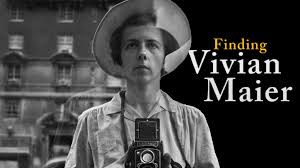
Vivian Maier was born on February 1, 1926 in New York City. Around the age of 25 or 26 she started taking photographs, about 100,000 or more pictures by the time she died on April 21, 2009, ninety-nine percent of which she never showed anyone. She worked as a Nanny and/or Housekeeper most of her life using her spare time to photograph in New York City, Chicago, a village in France, and on an eight-month world tour accompanied by her trusted twin-lens Rollie camera hanging from her neck. Her work was discovered two years before she died but she was unaware of it. It included documentary style photography, 8mm film and audio recordings.
Two years before she died, on April 21, 2009 in Chicago, storage lockers where she stored her work and other things were sold at auction for non-payment of the monthly fees. John Maloof bought boxes of negatives and went on to buy more boxes of negatives, undeveloped rolls of film, 8mm and 16mm movie film from other bidders later on. He discovered the inspired work of Vivian Maier and ultimately brought her photography to public attention.
Finding Vivian Maier Documentary. See trailer below.
There are now two documentary films about Vivian Maier. 1)The Vivian Maier Mystery, fifty-three minutes, released in 2013 by BBC. 2) Oscar Nominated, Finding Vivian Maier, 84 minutes, released in 2013/14 by Sundance Selects, directed by John Maoof and Charlie Siskel.
Vivian Maier Mystery Documentary
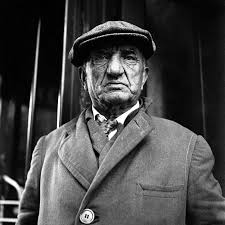
In addition there are several books, two of which are: Vivian Maier – Street Photographer, published by powerHouse Books and edited by John Maloof. The second titled Vivian Maier: A PhotographerFound also by John Maloof. Vivian Maier – Street Photographer is a great representative collection and introduction to Maier’s work. The book allows you to see through her eyes and get to know her through her work with no distractions. Maier has a well-developed sense of composition, contrast and focus. With the twin-lens reflex camera hanging from her neck she looked down into the view finder and shot from about waist-high most of the time. While she did shoot many self-portraits, she took herself out of the rest of what she shot. It seems like most of the time the subjects are not aware of her being there. She photographed everywhere from rough urban slums to elite suburban settings where she worked. She shot children, groups of people, portraits, street scenes and events with a journalist’s eye. Much of her work would have looked at home in Life Magazine of the 1950’s and 1960’s.
Vivian Maier had an eye for the ironic juxtaposition of people and their environment. For example a small boy standing on a wood frame looking into a very large box on a city sidewalk or a Father holding up his son’s leg to look at his shoe as the boy hangs on to him for balance looking uncomfortable. She also likes the light, texture and patterns seen in urban environments. Her portraits show something deeper than the faces of her subjects. Somehow she captures an intimate moment when someone’s personality pops up for a second. Her work demonstrates sensitivity to social and cultural aspects of what she shoots.
The Vivian Maier Mystery Documentary and Finding Vivian Maier Documentary, each have something to offer anyone trying to discover who this talented photographic artist is and how she got that way.
At first Vivian Maier does appear to be something of a mystery, a mystery she surrounded herself with. Both documentaries, through interviews with the grown up children and clients she worked for, mention how little they really knew about her and how secretive she was. She would not discuss her family or anything personal usually. However, on one of the tapes she made interviewing a woman about her meeting Rudolf Valentino, Vivian appears to do more talking than the interviewees including meeting she had with celebrities and her impressions of certain places she visited or lived in.
The Finding Vivian Maier documentary is longer and more in-depth in certain areas than The Vivian Maier Mystery because it has John Maloof interviews and access to his huge collection of photographs, negatives, and film footage that Vivian Maier shot. The Vivian Maier Mystery spends a bit more time looking into Ms Maier’s time in France and tracing her family. It also interviews collectors other than John Maloof.
There is a lot of controversy surrounding Vivian Maier and her estate that consists only of the copyright ownership of her work. She died with no known relatives except for a couple of second cousins in France. Maloof was able to get a release to publish and print the photographs from one of the cousins. Another collector, Jeffrey Goldstein, with 17,500 photographs also believed he had cleared rights until Cook County in Illinois, in charge of Maier’s estate, sent letters out stating that no one had clear rights to distribute the work. Cook County was searching for Vivian Maier’s brother who no one had seen, who disappeared scores of years ago and was presumed dead. Although Maloof had gotten permission from a living relative, he had not cleared it through probate court, so his permission deemed was not legal. Articles on this subject at http://www.vivianmaierprints.com/vivian-maier-articles.html
Prices for prints of Vivian Maier’s work are still available and costly. Jeffery Goldstein sold his collection to a gallery in Canada. Other galleries and Maloof are still selling prints. Vivian Maier did not print much of her work. She had the film developed and saved the negatives. So prints of her work have a third-party involved. Dark room printing of photographs is part of the photographer’s art. The good news is that her composition and framing were pretty specific so printers may be able to focus on contrast and exposure issues.
Aside from all the controversy Vivian Maier is an important American photographer and artist. The documentaries and books show her amazing life and work. The mysterious part is why she didn’t seek some sort of show or outlet for her work. It comes to light in reading the books and looking at the documentaries that at certain times she did try to show her work. For example she tried to negotiate a deal with a printer in France to make postcards from her pictures. Still she was secretive and didn’t push to show her work to anyone.
It is possible that Vivian Maier fancied herself as some sort of undercover photographer at certain times. She took on the role, and point-of-view of a photojournalist at times. She did interviews with people on her portable recorder on topical subjects like elections. She took pictures of celebrities and politicians. All her work is documentary in some form. Something in her personality prevented her from seeking employment as a photographer or seeking a wide audience for her work. If the postcards had been printed and sold, she would still be basically anonymous. Employers, their children and one or two friends all described Vivian as opinionated and at times argumentative or short-tempered. Although her work shows clearly that she had a sense of humor and progressive social tendencies.
Hopefully, when all the legal maneuvering is finished a traveling show of Vivian Maier’s work can be put together so that the world can see her work in person.
Review by James R Martin – Documentary Filmmaker, Author – Create Documentary Films, Videos and Multimedia
Trailer Finding Vivian Maier
[amazon_image id=”0982702329″ link=”true” target=”_blank” size=”medium” ]Create Documentary Films, Videos and Multimedia: A Comprehensive Guide to Using Documentary Storytelling Techniques for Film, Video, the Internet and Digital Media Projects.[/amazon_image]
The PBS – American Experience: Walt Disney documentary provides an uncensored, well researched, exploration of Walt Disney, the man, his work, and his passion for achieving goals. The 221 minute documentary looks into Walt Disney’s contributions to the art of film, his strengths and weaknesses. The film examines Disney’s great insight into American culture and at other times his opaque insensitivity to historical, political and social issues facing Americans. Walt Disney was an artist and an entrepreneur, greatly aided in his goals by Roy Disney, his brother, who complemented Walt’s apparent obsessive personality with practical nuance.
American Experience: Walt Disney informs and entertains. It is a great biography of Disney and the development of animated feature films. From a historical filmmaking point of view the documentary is a treasure trove of information, enhanced by the unlimited access given American Experience, to the Disney historical archives. There are photographs, and documentary footage of Walt Disney though out his life. Disney seemed to have someone there taking pictures or shooting activities all the time. The film’s narrative structure is greatly enhanced by this visual actuality of events. Interviews with people who knew Walt Disney also help tell the story. There is a linear chronology of Walt Disney’s life contrasted with events and life around him. Clips from classic Disney films are included throughout the documentary.
Walt Disney’s early attempts at creating short cartoons for distribution ultimately lead to the creation of Mickey Mouse, demonstrating Disney’s innovation including the first use of audio for an animated short. These early scenes in the documentary may be of particular interest to aspiring filmmakers as well as Disney fans.
One of the most interesting aspects of the documentary is Walt Disney’s idea to create a feature-length animated film that was Snow White and the Seven Dwarfs. Because of Disney’s determination to create a perfect, artistic film that transcended the notion that animation was only for cartoons, Snow White took five years to make and greatly exceeded its original budget. When it was finally released it was a huge national and international success. It achieved all that Disney intended, except winning an Oscar for Best Film. It did win an Oscar for innovation which didn’t really meet Disney’s expectations.
American Experience: Walt Disneyis set up in two parts that total four hours. It is well-edited and does not lag or get redundant. In fact there seems to be a pick-up of pace in the last hour to cover Disney Land creation, it’s success, the beginnings of Epcot, Disney World in Florida and Walt’s untimely death at age 65 from Lung Cancer. This is a biographical film about Walt Disney; however, it might have included more about his brother and alter ego Roy Disney. This is not to say Roy’s important role in Walt Disney’s life is ignored. It’s that Roy seems to always be in the shadows making things happen and trying to rein in his brother. It would have been interesting to know more about Roy and how he accomplished these things. Perhaps Roy Disney is another story.
The documentary does not gloss over Walt Disney’s problems with his employees, unions, his obsession with communists everywhere, or his insensitivity to minorities and racial stereotypes like those seen in Song of the South and other Disney films, television programs and other endeavors. In many ways it seems from watching the documentary that Walt Disney mirrored the cultural biases of his generation.
American Experience: Walt Disney does what an excellent biographical documentary should do. It explores reality, in this case the life of Walt Disney, with the goal of understanding who he was as a person and what he created during his lifetime. The successes, the failures and personality traits of a creative human being in the context of the world they lived in.
American Experience: Walt Disney aired on PBS in mid September 2015. It is available on Apple TV and on DVD from PBS and Amazon.
Review by James R (Jim) Martin – Documentary Filmmaker and Author
[amazon_image id=”0982702329″ link=”true” target=”_blank” size=”medium” ]Create Documentary Films, Videos and Multimedia: A Comprehensive Guide to Using Documentary Storytelling Techniques for Film, Video, the Internet and Digital Media Projects.[/amazon_image]
Trailer
DVD
[amazon_image id=”B00YJDHA7U” link=”true” target=”_blank” size=”medium” ]American Experience: Walt Disney[/amazon_image]
“…the Constitution, baseball and jazz music. They’re the three most beautiful things Americans have ever created.” – Gerald Early
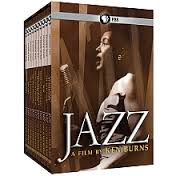
Jazz is one of Ken Burns’ best documentary films. Like most of his work the series transcends being solely a factual historical record. Burns puts the facts into historical and social context. Jazz, the documentary, fits the evolution of Jazz music in with American culture, Black History, people and politics of the United States. The history of Jazz, it turns out, is born out of circumstances uniquely American, to a large extent, in New Orleans of the 1890’s. Jazz —“It is a creation of the African-American community there, but incorporates all kind of music heard in the streets of what was the country’s most cosmopolitan city.” Jazz soon moves out of New Orleans and becomes a national passion. This documentary will either introduce you to Jazz or increase your appreciation and enjoyment of this music.
Documentary films come in many forms, evolving from the simple recording and editing of events to hybrid styles that incorporate fictional recreations of events. Ken Burn’s documentaries do not recreate events using actors. Instead he incorporates, often meticulously restored or discovered, archival photographs, film and documents, to create a narrative structure.
Ken Burns has created his own documentary niche. His forte is historical documentaries that delve into American culture and life since the Civil War. According to Erik Barnouw, in History of Non-fiction Film, Ken Burns is the only Documentary Filmmaker ever invited to be a member of the Society of American Historians. “Burns was the first ever elected without having written a book. Recognition of documentary as a medium for the writing of history.” –Barnouw
Wynton Marsalis
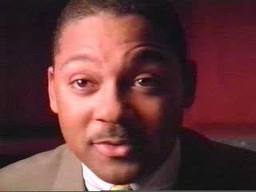
In the opening minutes of Episode One, musician Wynton Marsalis states, “Jazz music objectifies America. It’s an art form that can give us a painless way of understanding ourselves. The real power of Jazz, the innovation of jazz, is that a group of people can come together and create art, improvised art and can negotiate their agendas with each other, and that negotiation is the art.” Other interviews or commentary throughout the documentary by, Albert Murray, Gary Giddens, Stanley Crouch, Gerald Early and others give ongoing narration.
The story begins by introducing the environment, politics and culture of the day, then exploring how it all got that way. Individual artists are highlighted against the backdrop of their world. There are dozens of parallel themes that weave their way though this documentary. One theme, that also exists in other documentaries, like Civil War and Baseball by Burns, is the ongoing, vitriolic backdrop of race relations and racism in America. The documentary does not ignore racial segregation and the way black musicians were treated in America.
Another theme is the history of the country and the world to some extent. The major theme, of course, is exploring Jazz music; although some critics’ feel the documentary isn’t inclusive enough of all who contributed. Despite this possibility, Jazz does a great job introducing those interested in music to the subject and wetting appetites for more. Documentary films are visual and always subject to holding the viewer’s attention. Books can be read at any pace. Unlike a history book, of unlimited length and verbose explanations, a documentary film must be succinct, keep pace and fit into a time frame from which most people will view it. Music historians, experts and professors would do well to consider this as a documentary film intended for all audiences, not a history book. Even nineteen hours is not enough to cover the history of Jazz completely.
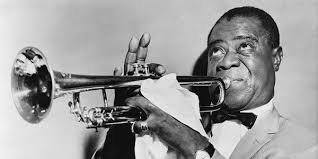
Louis Armstrong
Film and video are, primarily, a visual mediums. More recently sound has become a more equal partner in telling the story in film and video. However, the medium is still dominated by the visual part of the presentation. A contemporary viewer/listener can see and hear at the same time, absorb, understand and appreciate the visual/audio gestalt. As tempting as it might be, filmmakers do not have the luxury, in a documentary about music, to hold a picture or a blank frame, for the music to play for three minutes, so the composition can be listened to exclusively.
Ken Burns’ documentaries are notoriously long. At ten episodes, the total running time for Jazz is about 19 hours. But each of the ten episodes moves along at a good pace. Listening to Jazz, hearing Jazz artists and others talk about Jazz is not difficult. Perhaps because the music is so vibrant, the documentary often feels like a music video with actuality footage. There’s a lot to be learned here not only about Jazz but also about the America it evolved in and in-turn helped shape.
Jazz was aired on PBS in the year 2000. It reportedly cost $13,000,000 to make. That’s an average of $1,300,000 per, roughly ninety minute to two-hour, episode. In true Ken Burns, and traditional documentary style, there are no actors hired to recreate historic events. Historic archival photographs, film or video footage, interviews and voice-over narration by interviewees, historians and others are the basis for the story. It is well-edited and paced. You probably won’t “binge watch” all nineteen hours and that’s good, because there is a lot to enjoy, and think about. As Ken Burns has said, “meaning accrues in duration.” So take your time, enjoy and learn.
When Ken Burns said, “meaning accrues in duration,” he was originally referring to an editing style that usually takes its time. In the case of Jazz the editing pace is driven by the music, (497 pieces of music) which makes things feel like they are moving faster. There are times when it does seem the theme is digressing a bit too much into the context side of the story of Jazz, but not very often. Jazz both entertains and informs on many levels. The documentary offers a wonderful combination of music, and story. In the words of Ken Burns, “[Jazz] is the soundtrack of America.”
Ken Burns reflecting about his work in The Making of Jazz, a special short documentary on the first episode disc, mentions that he has spent a total 16 years of his life working on three films; Civil War, Baseball and Jazz. He mentions a quote by Gerald Early, “…when they study our civilization, two thousand years from now, there will only be three things that Americans will be known for: the Constitution, Baseball and Jazz music. They’re the three most beautiful things Americans have ever created.”
“And JAZZ is also a story about race and race relations and prejudice, about minstrelsy and Jim Crow, lynching’s and civil rights. JAZZ explores the uniquely American paradox that our greatest art form was created by those who have had the peculiar experience of being unfree in our supposedly free land. African-Americans in general, and black jazz musicians in particular, carry a complicated message to the rest of us, a genetic memory of our great promise and our great failing, and the music they created and then generously shared with the rest of the world negotiates and reconciles the contradictions many of us would rather ignore. Embedded in the music, in its riveting biographies and soaring artistic achievement, can be found our oft-neglected conscience, a message of hope and transcendence, of affirmation in the face of adversity, unequaled in the unfolding drama and parade we call American history. “ — Ken Burns
Trailer
Episodes
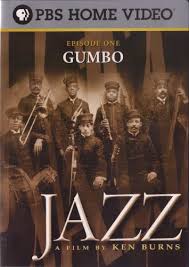
Episode One, 90 minutes, entitled Gumbo sets the stage for the birth of Jazz and traces the roots, music and culture that nurtured it in New Orleans. Some would dispute the notion that New Orleans was the exclusive “birthplace” of Jazz but the documentary makes a good case for New Orleans as the epicenter for the origins of Jazz. Wynton Marsalis and others add their personal, often profound, observations about Jazz including its evolution and artists. Even if you never watch the other nine episodes you will have a better understanding and feel for the roots of this American music form after watching this episode. It’s likely, however, that you will want to watch the rest of the story, especially, if you have a love of music and/or American history.
Episode Two, 120 minutes, entitled The Gift, captures the musical magic of this era and begins around the time of Prohibition, and a booming stock market. It introduces Louis Armstrong and Duke Ellington as well as Jazz development in Chicago and New York cities. Louis Armstrong’s life and his “gift” are explored. James Reiss Europe’s contribution to marching bands and Jazz music, set against the backdrop of WW1 and the African-American troops fighting in France. Duke Ellington’s Blessed beginnings in Washington DC. All of this at a time when Jim Crow practices and the Klu Klux Klan threatened minorities. This was a time when Jazz music was said to threaten the morals of young people dancing to the sound. By the end of Episode 2, Louis Armstrong brings his genius to Rose Land in NY City and Fletcher Henderson’s Band.
Episode Three, 120 minutes, entitled OurLanguage, Roaring Twenties, Prohibition, Bands and people who contribute to the evolution of Jazz. Bessie Smith and Ethel Waters sing the Blues, Bix Beiderbecke a white Cornet player from the Midwest, plays Jazz, Benny Goodman and Artie Shaw become a part of the scene. Dance bands with all white or black musicians play venues for all audiences in the mostly segregated world of the day. Duke Ellington played for white only audiences at the Cotton Club in New York City and is broadcast on radio all over the country. The Paul Whiteman Band became well-known. But in the end it’s Louis Armstrong’s amazing work that takes center stage. Armstrong along with Earl Hines record “West End Blues,” a truly classical piece of music, featuring Armstrong’s, Blues inspired, improvisational style.
Episode Four, 120 minutes, entitled The True Welcome, goes from the twenties to the stock market crash in 1929, after which some said the Jazz age was over. Up until that time musicians like Louis Armstrong, Duke Ellington, Fats Waller, Fletcher Hendricks, and other had played for small, mainly black audiences. As radio broadcasting of music came in and started to broadcast life performances, first Duke Ellington from the Savoy, Jazz became popular. People started dancing to a form of Jazz called Swing. Ellington ushered in the “Big Band” sound and was soon followed by other bands. Louis Armstrong set the tone for Jazz in the 1930’s when he started doing “skat” singing along with his trumpet playing. His style was known as “Black and Blue.” Chick Webb, a drummer put together a band that played at the Savoy in Harlem. Soon Benny Goodman came along with his band and three-hour Radio Broadcast. This episode covers a range of musicians who made their mark on Jazz. John Hammon, Billy Rose, Art Tatem and Jelly Roll Morton to name a few in this episode. In 1933 Duke Ellington brings his band to Europe playing numbers like Mood Indigo. Europe embraces Ellington and Jazz.
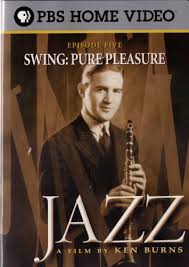
Episode Five, 90 minutes, entitled Swing Pure Pleasure, covers the mid 1930’s, Jazz goes mainstream with white musicians and bands. Benny Goodman, known as the “King of Swing,” Tommy Dorsey, Jimmie Lunceford, Glen Miller and Artie Shaw. Meanwhile Duke Ellington continues to builds in own sound and band. Louis Armstrong starts his band. Billie Holiday begins her career. At the end of this episode four thousand people come to the Savoy Ballroom in Harlem to see “The Music Battle of the Century,” a face off between Goodman and Chick Webb.
Episode Six, 105 minutes, Swing:The Velocity of Celebration, where two amazing Jazz tenor sax musicians emerge. Lester Young with own distinctive sound and Coleman Hawkins with his voice. In Kansas City Count Basie creates his own Jazz sound. Chick Webb, almost reluctantly, introduces Ella Fitzgerald to the world. Billie Holiday sings “Strange Fruit,” expressing her personal pain and indignation of racism in America. Duke Ellington tours Europe weeks before World War II begins.
Episode Seven, 120 minutes, Dedicated to Chaos, covers the Jazz world against the backdrop and chaos of World War Two. A lot is happening in music, from Charlie Parker’s improvisation and original approach on Alto Saxophone to the fact that 30 million Jazz music records were sold in 1940. “Swing” music and dancing were at a peak and big bands would go to war with the country. Louis Armstrong’s band toured the United States. Duke Ellington and his band had their own sound and style. Dizzy Gillespie trumpet is unforgettable. Billie Holiday sings Lady Day, Duke Ellington Orchestra performs his forty-four minute composition at Carnegie Hall with First Lady Elenore Roosevelt in attendance. Dave Brubeck talks about playing piano as a soldier in Europe. But when he returned to the US after the war his integrated band could not stay in the same hotel.
Episode Eight, 120 minutes, Risk, Charlie Parker’s genius is focused on as well as his tragic, short life. Parker and Gillespie invent a new Jazz sound called Bebop as Gillespie’s band tours the country. New artists, bringing new ideas, emerge including Miles Davis, Dave Brubeck, Gerry Mulligan and John Lewis. First International Jazz Festival held in Paris, 1949. Parker records an album called “Parker with Strings.” Bird Land, club named after Charlie “Bird” Parker, opened in New York City. In 1957, Miles Davis’s album, “Birth of the Cool,” made up of recordings from the late 1940’s, was released by Capitol records, establishing Davis and his music to a wide audience.
Episode Nine, 120 minutes, The Adventure, Jazz takes on different styles “the definition of what was Jazz and what was not began to blur.” Matt Glaser, musician states, “ When we talk about music, the reason we use terms that sound vague is not because there is anything vague about music, but because music expresses human experience so specifically, in such specific ways, that when you use language to describe that the words fall short…” In episode nine Charlie Parker’s career is ended by Heroin addiction. Miles Davis records on Prestige label with many well-known artists of the fifties and sixties. Clifford Brown establishes a no drugs life style. Sara Vaughn sings. In 1957 Louis Armstrong sees Little Rock disaster and refused to go on International tour for the State Department. Art Blakey and the Jazz messengers with Horace Silver and Jimmy Smith appear. Billie Holiday and Lester Young perform together. John Coltrane breaks new ground in 1961. Jazz takes an avant guard turn with Ornette Coleman and his quartet.
Episode Ten, 120 minutes, A Masterpiece By Midnight, essentially a wrap up from the 1960’s, of the entire documentary introducing artists and trends up to the year 2000 when JAZZ was aired on PBS. The narrative incorporates domestic and world events with the evolution and emergence of a number of trends in Jazz. Specific artists are also covered from Louis Armstrong’s unexpected hit with “Hello Dolly,” to artists like Max Roach, Charlie Mingus, Abbey Lincoln, Dexter Gordon, Charlie Bird, Duke Ellington, Miles Davis and others. So much has continued to happen to Jazz Music since the year 2000, that it seems time for a sequel in 2016.
LINKS
Amazon Purchase Jazz
[amazon_image id=”B000BITUEI” link=”true” target=”_blank” size=”medium” ]Jazz: A Film By Ken Burns[/amazon_image]
[amazon_image id=”1721679464″ link=”true” target=”_blank” size=”medium” ]Documentary Directing and Storytelling: How to Direct Documentaries and More![/amazon_image]
[amazon_image id=”0982702388″ link=”true” target=”_blank” size=”medium” ]Listen Learn Share: How & Why Listening, Learning and Sharing can Transform Your Life Experience In Practical Ways[/amazon_image]
[amazon_image id=”0982702361″ link=”true” target=”_blank” size=”medium” ]Actuality Interviewing and Listening: How to conduct successful interviews for nonfiction storytelling, actuality documentaries and other disciplines … (Documentary and Nonfiction Storytelling)[/amazon_image]
[amazon_image id=”0982702329″ link=”true” target=”_blank” size=”medium” ]Create Documentary Films, Videos and Multimedia: A Comprehensive Guide to Using Documentary Storytelling Techniques for Film, Video, the Internet and Digital Media Projects.[/amazon_image]
“A civilization without insanity, without war, where the able can prosper and honest beings can have rights, and where man is free to rise to greater heights, are the aims of Scientology.” –L. Ron Hubbard
The Going Clear documentary is based on a book written by Lawrence Wright, titled Going Clear: “Scientology, Hollywood and the Prison of Belief.” Scientology objects to the book and the documentary. As recently reported (8.5.2015) by the Guardian: the church, from its Los Angeles HQ, has denounced the film as a “one-sided, bigoted propaganda built on falsehoods” and informed by former members – whom it calls “misfits”.
In April, the church said in a statement: “The Church of Scientology will be entitled to seek the protection of both UK and Irish libel laws in the event that any false or defamatory content in this film is broadcast within these jurisdictions.”
Going Clear is a well-made film. Good editing and use of archival material and interviews. There is a lot of footage of Scientology events and places. Scientology officially calls it “propaganda.” But that label is not appropriate unless it can be shown that the filmmakers are misrepresenting the truth and hiding their true point-of-view (POV). A documentary film is not propaganda simply because you don’t agree with it’s premise or reality. One definition of a propaganda film is that is was made by a government, with a political philosophy or by institutions with missions. Going Clear does not meet these criteria.
Going Clear has a point-of-view that it doesn’t try to hide. All documentaries have a point-of-view. A documentary cannot help but be a subjective exploration of human reality. The fact that you do not agree with the point-of-view of a documentary does not make the documentary propaganda. Going Clear uses first person interviews from many people expressing their experiences. Evidence supporting the filmmaker’s POV is presented and explored.
Watching the documentary Going Clear: Scientology and the Prison of Belief brought back memories of a visit I made to East Grinstead in England, where there is a Scientology center.
Scientology Headquarters – East Grinstead
My friends Pam and Henry, talented painters and pottery makers, who I met in Harrogate, Yorkshire, had moved to East Grinstead. We kept in touch and when I came back to England to study film at the London Film School, in the early 1970’s, they invited me to visit them in their new home and studio in East Grinstead, a town in the northeastern corner, West Sussex. Not that it would have mattered to me, had I known, but Saint Hill Manner, in East Grinstead, was also the home of L. Ron Hubbard and the Headquarters for Scientology in Great Britain.
Pam and Henry had become Scientologists. They gave me a tour of the facility and some literature including Hubbard’s Dianetics, and a pamphlet of Axioms. They told me that Scientology was becoming a religion and was looking for recruits to become what sounded to me like ministers or perhaps monitors. I said, I was passionate about studying film but in any event could not afford to join Scientology. They said not to worry about money that “Ron would find a way.” I asked why Scientology was becoming a religion? They said to avoid persecution and get tax-exempt status. I chose to continue to study film.
I read the Dianetics book and other literature; some of it made sense on a practical level. But I never joined Scientology nor have I ever paid the Transcendental Meditation people for a mantra. I think “self-help” is a good thing, but do not like paying someone else to help me “self-help.”
The Going Clear documentary is a pretty straightforward expose style piece that mainly goes after the management of the International Association of Scientology (IAS) and the Church of Scientology. In particular it singles out David Miscovige, a self-appointed protégé of L. Ron Hubbard (LRH) and current Chairman of the Board, as a megalomaniac and serial abuser of staff. Going Clear also questions and explores the not-for-profit, religious status of this Billion-dollar corporation.
David Miscavige, Chairman of the Board
Going Clear begins with a history of L. Ron Hubbard and how he ultimately founded Scientology based on his Dianetics Book. In addition to interviews with Sara Northrupt, Hubbards first wife, the film uses a some interviews, archival photographs, video and a few minor, apparent recreations to tell the story. The film depicts LRH has a prolific author of science fiction, much of which is incorporated into the back-story of Scientology. A number of insiders, like Paul Haggis, Jason Begle and Spanky Taylor, who have left Scientology after long association, paint a grim, behind the scenes, picture and how Miscovige consolidated his power and keeps people in line. They also discuss what amounts to a form of brainwashing they believe is practiced in Scientology.
Going Clear also looks at the auditing process which is the corner-stone of Scientology and the way one becomes “Clear.” Using a device, with two cans that one holds and that are connected to a meter, electrical impulses are monitored during what is called and “audit.” This contraption has been characterized as one-third of a lie detector machine. The person doing the monitoring asks questions and makes copious notes of each session. People who join Scientology pay to go through a long series of audits on what is called a “bridge” to becoming clear and ultimately achieving “Theata” status.
Two celebrities who are well-known Scientologists are focused on in the documentary. They are John Travolta and Tom Cruise. Neither Travolta nor Cruise was interviewed for the Going Clear documentary but there is still plenty of footage of them in the film. Travolta joined Scientology early on in his career. He seems a fairly non-controversial member. Tom Cruise’s story is different, especially during the time he was married to Nicole Kidman. The documentary makes the case that Miscovige interfered in the marriage, secretly, and later overtly, because he believed Kidman, who he labeled in Scientology speak, “a suppressive person,” was pulling Cruise away from Scientology. After Kidman and Cruise divorced, Tom Cruise was back, prominently representing Scientology as a spokesperson.
The Going Clear documentary goes beyond perceived and documented issues it finds with Scientology. By default it brings attention to the tax-exempt status of some institutions that seem more about making money than any kind of not-for-profit mission. It also may ask exactly what constitutes a religion? Is Scientology posing as a religion? Did Scientology harass the IRS into giving it Not-For-Profit, status as a religion, which also gives Scientology certain First Amendment protection. Are there other institutions in the same category? There have been other negative documentaries and book about Scientology. Going Clear: Scientology and the Prison of Belief is hard to ignore.
HBO – 120 minutes – Directed by Alex Gibney
Review by Jim Martin, documentary filmmaker, writer, director and author.
Books by James R Martin
[amazon_image id=”0982702329″ link=”true” target=”_blank” size=”medium” ]Create Documentary Films, Videos and Multimedia: A Comprehensive Guide to Using Documentary Storytelling Techniques for Film, Video, the Internet and Digital Media Projects.[/amazon_image]
Making a short documentary isn’t much different from making a long documentary in theory. But in practice it can be a lot more difficult. There are many unique factors involved in a short form documentary or fiction films that need to be considered. For starters it’s easy to make a “long” documentary that will put people to sleep after the first minutes. Making a three-minute or seven-minute documentary presents several issues that involve planning and knowing what you want to do.
Let’s say there’s some great equipment available (we’ll talk more about equipment later) and an event about which you want to make a short documentary. Someone with little experience might think that all they have to do is get a ton of coverage and then edit it down to make their documentary. Just shoot everything that happens. Maybe use a couple of cameras to make sure they get it all. The next day with twenty Terabytes of footage to edit down to seven minutes where do they start? It’s an overwhelming task because there was no plan, no direction, and no concept about what would really be done with all this footage. No preconceived notion of a story or how it would be told.
Shooting twenty Terabytes of coverage of an event, with no particular story concept in mind, is nothing more than shooting archival footage. The event has been documented but that’s where it ends. Is it possible to pull a story of sorts out of all the footage? Sure, but archival in, is archival out. A documentary begins with the goal of telling a story about the event that gives the viewer a subjective interpretation of what happened. While the archival footage, is also subjective in the end, it’s purpose was to simply record the event. It is like C-Span coverage of congress. The coverage is usually from chosen, locked off, camera positions, lens choices and angles. It’s hard to stay engaged watching this type of video.
The place to start with a documentary idea, is with a concept and treatment about the subject for the story. What’s the story? Where do you want to go with this story? Who are the characters in this story? Who is the audience for the story?
Let’s say the event is one that happens once a year in an urban community. It’s been going on for a several years as a charitable event, is well attended and participation is high. People have fun and the competition involved in the event is not taken too seriously or is it? Here’s an example.
For the past eight years there has been a “Doggie Derby” held in Baldwin Park, a moderately upscale community in Orlando, Florida. The concept is to put together a short documentary that in a few minutes gives the festive feel of Doggie Derby Day in Baldwin Park and the people and dogs involved. But we still don’t have a story. This is only an idea.
That’s where the Treatment comes in. A treatment narrative conveys the story line, beginning, middle and end. Also the style and approach to be used in telling story.
A basic treatment lets the director know what the story is about and a basic approach to telling the story. For a short documentary the treatment doesn’t have to be very long. The idea is to pre-visualize how the story will be told and what it will look like on the screen.
There could be a bigger story here but the goal is to keep it short and still give the viewer a real feel for what goes on at the event. The treatment establishes an opening that includes some establishing shots, background if possible, shots of the people and dogs. More footage of the actual dog racing and how the participants, two-legged and four-legged, react to the proceedings. The style of shooting is intimate which means close-ups of people and action. The story starts with establishing shots of the venue, people and action. Once the action is established a short interview with the organizers; “how did the Doggie Derby get started?” Then show more action, dogs racing, people watching and enjoying the event. Interview couples that have entered their dogs and why they do it. Other interviews if possible. Story ends with awards to winners of the last races.
If a longer more in-depth story was required, the treatment could go into more detail about each area. For example while the interview with the organizers goes on, voice over archival footage of earlier year’s events is included. More interviews and questions asked of more people. Interviews with winners and other participants also possible. Vendors who sponsor the Doggie Derby each year would be interviewed. Show and interview volunteers who help set up the venue. Keep track of each race and interview finalist as they progress toward the Grand Champion race.
The outcome of all the races or what people will do or say is not known. But a shooting script to further develop the concept and treatment could be written. This script is more about what the filmmakers will do than what the subjects will do or say. A full shooting script is not always necessary or practical. It would be great if earlier years were attended or the organizers talked to in advance so that there is an idea of what may be happening. A shooting script for a documentary is in some ways a “wish-list” of what is needed to tell a story. But documentaries are exploratory; things may be very different from what is expected. The pre-production, concept, treatment and a shooting script are a way to get the director out there with some ideas about how to tell the story, whatever it turns out to be.
After the shooting is finished and coverage logged and reviewed, an editing script should be written so new information and actual footage may be molded into a story that has a beginning, middle and end. Editing can go ahead without an absolute fixed length for the story. Edit for story and pace not time. Trying to stretch footage to get to a certain length will be obvious and the quickest way to lose an audience. Of course some time constraints may exist, usually it’s a matter of tightening up and not adding scenes. Be ready to throw your favorite shot under the bus if it doesn’t add to the story.
The Doggie Derby Day story was envisioned a few days before the actual event. It was based on the director having attended the Doggie Derby in earlier years. The idea was to spontaneously tell a simple story that gave a feel for the event as described above. This was also a time to test out some lightweight equipment for use in fluid documentary situations using very small crews.
In this case the “crew” was a Director/camera operator, Production Assistant/recorder/microphone holder and a second camera operator, primarily for action and production stills, and some video.
EQUIPMENT
In a earlier post theCanon 7D Mark II and Atomos Ninja Starwere reviewed for their potential use in a documentary situation. Doggie Derby Day provided a multifaceted test for the equipment including portability, quality, ease of use and practical field-testing. In addition a Zoom H1 was used as a microphone/recorder to work double system.
The ZOOM H1 was hand-held most of the time by an assistant. It was also used attached to a heavy-duty photography “L” and flash shoe mount bracket that also held the 7D Mark II. The Ninja Star was attached to the 7D hot shoe. This rig was set up to test one-person operation. A shoulder mount was available but not tested this time around. A tripod was available but not very practical for one person at this type of event (Think doggie POV using a tripod?). A Canon 6D was used by a second camera operator who shot production stills, action stills and supporting video.
The Canon 7D Mark II with the Ninja Star mounted on the hot shoe is lightweight. Attaching an “L” bracket to the camera offered two-handed shooting, and one-handed shooting using either hand. The Zoom H1, microphone/recorder is very light and easily mounted to one of the shoes on the bracket. An alternative might be the Zoom H5 with a shotgun microphone. A wireless lavaliere microphone could also be used with either the Zoom H1 or H5 as there is an input for an external microphone on both, but only the H5 has XLR inputs.
An intimate feel was desired for the Doggie Derby Day documentary. Using a zoom lens was possible and the Canon 28mm to 135mm F3.5 – 5.5 was used for a few shots, but the bulk of the shooting was done with the Canon EFS 24mm F.2.8 STM with its tiny lens hood. The EF-S Mount Lens is APS-C matching the 7D Mark II format (38mm – Equivalent for 35mm full frame) . This small prime lens performed perfectly for this situation. It focuses quickly and quietly utilizing the camera’s Movie Servo AF mode. This lens allows close-ups to be shot without distortion and wide shots as well. No zooming of the lens all the time to change focal length. Instead the camera is moved closer or farther from the subject (Isn’t that a novel idea?). The prime lens has sharpness and is lightweight.
Setting up the Canon 7D Mark II to work with Atomos Ninja Star is not difficult but certain guidelines must be followed for settings in the camera’s Menu. Please see https://www.jrmartinmedia.com/director/canon-7d-mark-ii-and-ninja-star/ for set up instructions. This set up, apparently by default, provided “proxy” H.264 .mov files including picture and sound in the camera, the same footage that was being recorded in HQ4.22, Pro Res on the Ninja Star. To avoid recording to the camera memory, push the record button on the Ninja Star instead of using the camera trigger. The footage will only record to the Ninja Star.
Zoom H1 and Ninja Star both mounted on “L” bracket leaves hot shoe free. Also may work well with LED viewfinder attachment and shoulder mount.
The 7D Mark II has two memory cards that can be set so that the camera automatically switches to the second card when the first is full. To prevent interruption of shooting, change out the CF card in the camera when it is 90% full and set the camera to switch to the second card when the first is full. In a pinch you could continue shooting using the second card. The camera will not record if the memory cards in the camera are full.
Post production and editing for a short documentary film depends on how well the pre-production and production went. After importing the footage into an editing program, the first step is to log and review all the footage. In the case of Doggie Derby Day there were two types of footage plus photographs to import into Final Cut Pro. All of the footage recorded on the Ninja Star was Pro Res HQ 4.22. This imports in to Final Cut natively, since Pro Res is what Final Cut edits with. Footage recorded to the Canon 7D Mark II was H.264, but Final Cut Pro has an optimization setting that upgrades the H.264 to Pro Res for editing. The other footage shot with the Canon 6D was also optimized to Pro Res when it was imported into Final Cut Pro. So all the footage was compatible and seamless. Photographs can also be imported and optimized.
Editing a short documentary with Final Cut is a subject for another article. Final Cut Pro, once you understand how the program works, is not difficult. It facilitates editing creatively and quickly. For experienced editors there is an unlearning process that involves track based editing vs Final Cut’s non linear story structure editing. Whatever non-linear editing (NLE) program you use it’s important to have a plan.
James R (Jim) Martin, Documentary Filmmaker and Author Create Documentary Films, Videos and Multimedia.
[amazon_image id=”0982702329″ link=”true” target=”_blank” size=”medium” ]Create Documentary Films, Videos and Multimedia: A Comprehensive Guide to Using Documentary Storytelling Techniques for Film, Video, the Internet and Digital Media Projects.[/amazon_image]
Here’s an example of a short documentary (Seven minutes) that went on to win a Tely Award.
This past Saturday was Doggie Derby Day held in Baldwin Park, Orlando, Florida for the past several years. An event for dogs and people founded eight years ago by Bob and Julie Hemphill this nonprofit Bright Side Event is a great day for everyone and their best friends. Fresh air and exercise for all concerned. This short documentary offers a look at some of the activities during the event. It is fun time for all involved. Most of the canine competitors opted for no interviews but a few did bark a reply.
Nominated for an Oscar in the Best Feature Length Documentary category 2015, Virunga, a Netflix movie, is a story that takes the viewer into the chaos of the war-torn Eastern Congo and Virunga National Park in the Congo, where dedicated Park Rangers struggle to protect the last of the Mountain Gorillas and preserve the park and its residents.
Poachers endanger the gorillas. Park rangers discover a massacre of gorillas by people trying to exterminate them for the land. Militia groups, including the rebel group M23, make war against the Congo government adding another layer of fear. International corporate entities interested in the rich natural mineral resources of the area, including drilling for oil in Virunga National Park, create a situation where Park Rangers and officials are at odds with SOHO the oil exploration corporation. While the humans fight for their piece of the pie, Verunga National Park, a UNESCO World Heritage site, and its inhabitants, animals of all types, become vulnerable. For some interests, the gorillas, and all the other animals are expendable.
One of the themes in the documentary involves three young orphaned gorillas rescued by the Park Rangers and now in their care. As the war encroaches on the park the care of the young gorillas becomes increasingly more difficult. Seeing these young gorillas and their affection for the Rangers is heart warming.
It seems that the animals and humans in and around Virunga face similar problems as the war engulfs their constant struggle for survival. This documentary does an excellent job of telling the story by being there in the park. The filmmakers are with the rangers, the oil company (SOHO) security, the indigenous people living in the area, government soldiers and rebels as events progress. The documentary shows the refugee camps on the southern border of Virunga Park where thousands of people are living displaced by the rebels and war. Interviews and conversations with certain characters seem to be done without the interviewees knowing it. This is a pretty risky tactic for the filmmakers if they are caught since value for a person’s life is low.
VIRUNGA combines nature documentary and journalistic reporting from a war zone. The filmmakers face many life-threatening situations as they go with Park Rangers through the park to check on the gorillas and other animals. The rangers must deal with poachers and rebel militias.
VIRUNGA is a story that demonstrates the cruelty and greed of humans and the humanity shown by a few people in times when all around them is made hostile.
VIRUNGA is a documentary film that brings into focus the realities of this area of Africa and perhaps sheds light on some of the problems facing many of the former European colonies in Africa. The indigenous people have no history of self-rule. Even with independence they are still fair game for exploitation by international corporate entities that can buy their way into these countries.
VIRUNGA — Directed by Orlando von Einsiedel, Produced by Joanna Natasegara and Orlando von Einsiedel, Cinematography Franklin Dow, Editor Masahiro Hirakubo. A NETFLIX FILM – 100 MINUTES – COLOR
Review by James R Martin, Documentary Filmmaker and Author Create Documentary Films, Videos and Multimedia
Trailer
httpv://www.youtube.com/watch?v=wxXf2Vxj_EU’
Virunga Available on NETFLIX
Links to books by James R Martin
[amazon_image id=”0982702361″ link=”true” target=”_blank” size=”medium” ]Actuality Interviewing and Listening: How to conduct successful interviews for nonfiction storytelling, actuality documentaries and other disciplines … (Documentary and Nonfiction Storytelling)[/amazon_image]
[amazon_image id=”B0799P7HNJ” link=”true” target=”_blank” size=”medium” ]Listen Learn Share: How & Why Listening, Learning and Sharing can Transform Your Life Experience In Practical Ways[/amazon_image]
[amazon_image id=”0982702329″ link=”true” target=”_blank” size=”medium” ]Create Documentary Films, Videos and Multimedia: A Comprehensive Guide to Using Documentary Storytelling Techniques for Film, Video, the Internet and Digital Media Projects.[/amazon_image]
CREATIVITY – the perfect crime by Philippe Petit is an excellent documentary style nonfiction book that offers an amazing amount of insight into the author’s creative process and how the reader might adopt some of those ideas. “If you don’t know what the rules are, it is easier to break them.” “Go to extremes to shelter your creative process from negative influences.” — Philippe Petit – Creativity — the perfect crime.
Machu Picchu is one of those places I’ve always wanted to visit. While in the Army, Leon, and I went to the Boston Library and started researching a possible journey we could take when our enlistments were up. We were researching the Inca Trail and Machu Picchu. Of course we soon discovered that there was a train that went along the Inca Trail or to Machu Picchu. This took some of the adventure out of the idea. I think we thought the Inca treasure might still be out there.
Reading Mark Adams book Turn Right at Machu Picchu, all these years later has brought back not only the sense of adventure but also, after reading the book, a feeling that I’ve been there. Documentaries (nonfiction stories) come in all forms. Adams takes you step-by-step through his own experience and the history of Peru as it relates to the Inca civilization, the Inca Trail, Machu Picchu and other ruins in the area. The Inca civilization didn’t last that long, especially after the Spanish arrived in 1532. But the indigenous people of the Peruvian Andes, who speak Quechua, still live in the area around Machu Picchu and Cuzco.
A major part of the story evolves around Hiram Bingham III, who in 1911 basically brought Machu Picchu into the limelight along with the notion that it was the Lost City to which some of the Inca’s, with their
Hiram Bingham III
Gold and Silver treasures, retreated from the Spaniards. In 1913 National Geographic featured Bingham’s travels in one edition that brought Machu Picchu, Bingham and National Geographic into prominence. Bingham was a controversial character and went on later expeditions to Peru. According to Adams he may have been the inspiration for Indiana Jones character in Raiders of the Lost Ark. Adams layers the historical facts with his travel progress so that the book has a narrative cinematic quality. There are some well-drawn maps and black and white photographs included in the book. There is also a glossary that helps with pronunciation of some of the Quechua (Ketch-wah) names.
Mark Adams and John Leivers
Adams writes he “wanted to retrace Bingham’s route through the Andes on the way to discovering Machu Picchu” along with looking at other important locations. Turn Right at Machu Picchu is more than one man’s journey of exploration and discovery. It leaves you with a feeling that you’ve gone along on this adventure, done the research, heard the many stories, met the intrepid guide, John Leivers, who’s experience makes the journey possible, hiked the mountains, hiked the Inca roads and seen the awesome Apu (mountain) views. There’s also a supporting cast of characters including local Peruvian mule handlers, cooks and others.
Turn Right at Machu Picchu offers new appreciation and insights into Inca architectural and astronomical accomplishments. The Inca employed a method of building with stone and granite that, without the use mortar, brought the blocks together as flush as any modern building. The built hundreds of miles of small stone paved roads up and down mountains that connected various parts of their dominion. They aligned their cities by the stars and had buildings with windows that would capture the solstices on the proper days.
The Inca Trail
If you are planning a trip to Peru, Machu Picchu and the Inca Trail, Turn Right At Machu Picchu is a must read and might be something to stuff into your back pack. You can also be an armchair adventurer, this book will make you feel like you are there. No need for a TV, the words create the pictures.
Review by James R Martin – Author Create Documentary Films, Videos and Multimedia
[amazon_image id=”0452297982″ link=”true” target=”_blank” size=”medium” ]Turn Right at Machu Picchu: Rediscovering the Lost City One Step at a Time[/amazon_image]
[amazon_image id=”0982702329″ link=”true” target=”_blank” size=”medium” ]Create Documentary Films, Videos and Multimedia: A Comprehensive Guide to Using Documentary Storytelling Techniques for Film, Video, the Internet and Digital Media Projects.[/amazon_image]
A look at the new Canon 7D Mark II, the new Atomos Ninja Star Pro Res recorder and how they can be used together to shoot Pro Res HQ 4:2:2 or 4:2:2 footage. Also how the Ninja Star can be used with the Sony A6000 to get equally great video with a relatively small package and price.
Technology, when it comes to photography, film and video, never ceases to amaze me. Advances in equipment and resources over the past forty-five years boggles the mind; if you consider what technology existed for professional production back in the 1970’s. If I had all this wonderful, relatively modestly priced gear back when I got out of film school… But that’s another story.
This story is about the new Canon 7D Mark II, the Ninja Star and the Sony A6000.
First Canon’s new 7D Mark II is a significant upgrade from the 2009 7D. It’s an amazing tool for both still photography and video production. As an owner of the original Canon 7D I thought long and hard about whether to upgrade to the 7D Mark II at about $1799 for the camera body. All my EF lenses are compatible with the new camera so I only need the body. I did consider a Canon 5D Mark III and/or it’s anticipated upgrades due out soon. But there is a big price difference.
I use the 7D for still photography and video. The still photography quality is excellent and the video is good. But I always felt the camera was primarily suited for still photography. Even after a firmware upgrade allowed the audio to be manually controlled, the camera sound recording was only suitable for a scratch track or home movies. But acceptable audio may be recorded externally working double system. With the right rig some decent documentary footage could be shot.
While waiting for the new Canon 7D Mark II to come out I bought a Sony Alpha a6000. This is an amazing, mirrorless DSLR (interchangeable lenses) that is very small but big on quality with 24.3MP APS-C Exmor APS HD CMOS sensor. It produces high-resolution photographs and full HD movies in low light with ISO sensitivity up to 25,600. Street prices for this camera with a lens are around five to six hundred dollars. The camera has complete manual or automatic shooting options and records HD 1080 Progressive or Interlaced footage at a number of frame rates. Great camera for shooting stills or video without attracting attention, however, audio still needs to be recorded on an external device like the Zoom H1, available for $99. This small digital recorder can be mounted on the camera’s hot shoe or handheld. One problem with mounting a recorder or microphone on a DSLR is it will pick up camera sounds like servomotors, auto focus and sounds made while zooming.
The Sony A6000 uses micro four-thirds lenses like the Black Magic Pocket Camera but the a6000 has a Sony E mount. An adapter can be purchased to convert the Canon EF mount to the Sony A6000, however, some functionality may be lost depending on the lens. The a6000 will also work with the Ninja Star.
I decided to buy the Canon 7D Mark II after looking at the specs and reviews of the camera. It seemed like it would be great for all types of production including still photography and digital video. One important aspect of the camera is the uncompressed output from the HDMI port on the camera.
My earlier experience and knowledge of the original Canon 7D was helpful, but more of an introduction to the Mark II. The little booklet that comes with the camera is a quick start guide but it’s necessary to download the User Manual from Canon to get really familiar with all the features and functions of the camera. You can set it on “Auto” and basically “point and shoot,” but that would be a waste of the amazing amount of potential the Canon 7D Mark II offers.
The Canon 7D Mark II is built to allow the shooter all kinds of options that can be programmed or accessed easily on the fly. The super 35mm, APS-C-sized 20.2MP CMOS sensor, and dual DIGIC 6 image processors make this DSLR well suited for all types of production. The Canon 7D Mark II has a 65-point all cross-type phase-detection Auto Focus (AF) system and Dual Pixel CMOS AF technology. This is ideal for accurate focusing for both the optical viewfinder and live view shooting. Live view shooting on the 3.0” LCD monitor is available for both still photography and video. It records full HD 1080p/60. Movie formats: H.264, .MOV, MP4 are all compressed formats. The HDMI output is uncompressed.
Photographs may be shot in .JPG and/or Raw. The compressed video (.MOV) quality is excellent and can be imported directly into Final Cut Pro or other editing software. With a high native ISO speed of 16,000 (expandable to ISO 51,200) you can shoot in very low light situations. There are white balance options, manual aperture, shutter options and menu options for the in camera video and the HDMI output. The camera has audio in and out as well as a built-in microphone. There are excellent in-depth reviews of the Canon 7D Mark II features online including B&H Photo.
Initial test shooting of stills and video (using double system sound) went well with a one-person handheld rig including a Zoom H1 recorder for the audio. The camera is easy to handhold even with one hand, but using a zoom lens and holding a recorder can be difficult. Mounting the H1 recorder on the hot shoe is an option if you turn off the Auto Focus. There are brackets that are available that allow the offset of the microphone or recorder. This may help to stop the recording of camera and lens focusing sounds. Disabling auto focus options in the camera menu can minimize the clicking the lens makes trying to focus on something. One option, for picking up ambient sound working hands free, might be to wear a lavaliere microphone and connect it to the camera or the recorder to pick up ambient sound away from the camera. Double system, recording audio separately, using a sound recordist, is the best idea.
Both the Canon 7D Mark II and the Sony Alpha a6000 are excellent cameras for certain applications. They produce stunning results and have advanced features on their own. Still if there is away to kick up the video quality and get uncompressed ProRes 4:2:2 footage, it seems a good idea. Up until recently one way to do this was to buy an Atomos Ninja 2 monitor/recorder for $695.00. The Ninja 2 is a fine device and can be used with many cine cameras including the Canon C100. But Atomos has come out with another smaller device without a monitor for $295 that is perfect for a DSLR like the Canon 7D Mark II, the Sony Alpha a6000 and a number of other cameras. (Other cameras supported)
The Atomos Ninja Star Pocket-Size ProRes recorder and deck is a great addition to the Canon 7D Mark II if you want to get professional HD ProRes footage to edit. Here are the basic specs:
Records 1080p 10-Bit, 4:2:2 via HDMI
ProRes HQ, 422, and LT Codecs
Micro HDMI Input & Loop Output
Stores to CFast Cards
Audio Line-In
Audio Level Indicators
Battery Life & Time Remaining Indicators
5 Hour Battery Life
Mounting Plate with 1/4″-20 Thread Holes
Lightweight at Only 4.6 oz
There are a number of settings that need to be correct on the Canon 7D Mark II before it will work correctly with the Ninja Star. The Ninja Star recognizes the Time code of the HDMI footage coming from the camera. So you need to have the Time code turned on and running. In addition the Record Command setting under Time code must be on. If all the menu settings are correct you can control the start and stop recording from the 7D Mk II start button.
Levitated Mass, directed by Doug Pray is a documentary that has appeal as an adventure story, exploration of the place of monumental art in America, the work of an artist with and alternative view of space and time, and it all revolves around a 900 million year old rock. Levitated Mass is the saga and implementation of an idea originally envisioned in 1968 by artist Michael Heizer.
Levitated Mass is a well-made documentary that both informs and entertains. Doug Pray’s previous documentaries include “Yelp.” “”Scratch,” “Big Rig,” and “Art & Copy” among others.Levitated Mass will keep you involved and finding answers to questions you may come up with while watching. This is a story about many things including art and how it relates to life for the artist and the audience.
The Levitated Mass adventure begins when Heizer finds a huge granite boulder, a survivor a 2005 quarry blast, that meets the vision he has had for the rock he wants to use for a monumental sculpture. Heizer contacts Michael Govan, Director of the Los Angeles County Museum of Art (LACMA) who agrees to take on the project, including moving the two and half story tall, 1.2 million pound rock to the museum site in LA County, from a quarry near Riverside, California 105 miles away. Moving something heavier than a 747 airplane over the roads and through 22 cities, each with their own laws and permitting process, is no easy task. But the journey, as seen in the documentary, engages the imaginations of thousands of people along the route. Interviews with spectators in various places along the way allows the documentary to explore how this part of the experience engages the public who now feel they are a part of this work. The “Rock” is a celebrity passing through town for all to see.
[box] “We’re living in a world that’s technological and primordial simultaneously. I guess the idea is to make art that reflects that premise.” Michael Heizer, Sculpture in Reverse 1984 [/box]
Moving the rock is only part of the story. A concrete space needs to be built for the installation to hold the rock, levitating so that people can walk under it and all around it. Through out the story Michael Heizer’s work, installations from all around the world are shown. In the process a fundamental understanding of his concepts of negative space and monumental sculpture comes across.
Levitated Mass documentary starts with a planned explosion at the quarry where the pure granite “rock” was born. When the dust settles in the private quarry near Riverside, California the rock and some back-story are introduced. Archival footage going back to a sculpture done by Heizer in 1969, in Bern, Switzerland and combined with interviews are important to the documentary in that they furnish insight into the seriousness of Heizer’s work and the philosophy behind it. His work controversial at times, too large for museum interiors; Heizer moved his work outside. He is perhaps the originator of what has come to be called “Land Art.”
A large part of the of the documentary is the preparation and actual moving of the “Rock” from the quarry near Riverside, California to the Los Angeles County Museum. A colossus transport vehicle 450 feet long is put together to hold and move the rock at a snail’s pace from city to city. Permits are required and the route must be planned so as not to destroy highways, bridges and overpasses along the way. This is a monumental journey even with modern equipment and resources. A reminder of what ancient civilizations may have faced moving non indigenous rocks to build Stonehenge or sculptures in Mexico.
Levitated Mass is an important and entertaining documentary on many levels. The pace, editing, cinematography and story bring new insights forward as well as questions about the role of art, in particular large sculpture, in the modern world. Also what will this current civilization leave behind for succeeding civilizations? What will be the modern pyramids, Stone Hedge or other edifices seen 500 or a 1000 years from now?
[amazon_image id=”0982702329″ link=”true” target=”_blank” size=”medium” ]Create Documentary Films, Videos and Multimedia: A Comprehensive Guide to Using Documentary Storytelling Techniques for Film, Video, the Internet and Digital Media Projects.[/amazon_image]
[amazon_image id=”0982702361″ link=”true” target=”_blank” size=”medium” ]Actuality Interviewing and Listening: How to conduct successful interviews for nonfiction storytelling, actuality documentaries and other disciplines … (Documentary and Nonfiction Storytelling)[/amazon_image]
There are many ideas about what makes a documentary film. But a true documentary does not use actors or have scenes “recreated” based on a true story or not. The 2014, 386 page, third edition of Create Documentary Films, Videos and Multimedia is a book that looks at the craft and art of telling nonfiction stories, in particular, in a documentary style. Written by James (Jim) R. Martin it is based on over 33 years of teaching filmmaking and forty years making award-winning documentaries. The following is an excerpt from the beginning of Chapter Two on development.
Developing and Researching Documentary and Nonfiction Projects
“My aim as a filmmaker is to approximate some of the complexity of the real world, rather than to simplify it” – Frederick Wiseman
Considering and Selecting an Idea for a Documentary Project
When considering ideas for a documentary, think about the feasibility of doing the project and how it might be approached. What is the story? Is the idea something that can be accomplished with the resources available? How likely is the cooperation of the people, the institutions, government or officials involved?
It’s one thing to have an idea for a documentary, it is another to conceptualize the idea and come up with an approach and a point-of-view on that subject. By taking certain steps in the process of developing an idea it is possible to see where the story might be and what areas to explore. A documentary story begins with an idea, notion, questions, problem or issue, that can be explored.
There are many ways to structure a story but all of them must be comprehensible to your audience. All stories have a beginning, middle and end whether they are fiction or nonfiction/documentary. Stories are a narrative including events, conversations, action, reaction and observations that include whatever conflict and tension that naturally occurs in the nonfiction material and whatever conflict and tension the storyteller builds into telling the tale. In a documentary context the storyteller may use existing conflict to tell the story but not distort the conflict to create false arguments or themes. As in all storytelling from a joke to an epic novel, timing, structure, pace and delivery are important.
The best stories engage the audience in a way that brings them into the process, allowing them to discover, ask questions (which at some point are answered) and that evokes emotion. Questions to consider about ideas are; will it shed any new light on the subject? How interesting is the subject and how much time will it take to present it. Is the subject large? If it is a large subject, on what area will it focus?
The approach and process depend in part on what the subject is and the context of how the documentary will be used. An educational film on a given subject may be approached differently than a social advocacy documentary. However, there are some basic steps to at the beginning of the journey.
Other topics covered in Chapter Two include:
Audience Researching Exploring Asking Questions Find the Story Consultants Where to Begin Writing a Concept and Treatment Writing a Shooting Script
In many respects Create Documentary Films, Videos and Multimediais a documentary itself, as it includes step-by-step directions on telling documentary stories and case studies based on the author’s experience making documentaries in all types of situations, from feature-length documentaries seen nationally on PBS, to short documentaries for not-for-profit clients.
Making documentary films is more than theory and more than knowing how to run equipment. Making documentaries combines theory, technical expertise and storytelling style. Create Documentary Films, Videos and Multimedia combines elements from all areas to bring to the reader the real craft, and rich tradition of making and telling actuality or nonfiction stories. Stories now known as documentary. Documentary style story telling is not confined to films and videos. The book looks at other forms of documentary presentation including still photography, books, audio presentations, slide presentation and other forms.
Your Inner Fish is a well made television style documentary, three episode series. Episode 1 – Your Inner Fish, Episode 2 – Your Inner Reptile and Episode 3 – Your Inner Monkey. All three episodes are entertaining, informative, and offer a trip through time going back to when prehistoric fish swam in the oceans and animal life on dry land apparently didn’t exist. The story delves into areas of research that have changed what was thought to be true up until now.
The Your Inner Fish series is one from which everyone can learn. The documentary presents facts and offers evidence to support the ideas explored. In addition to Neil Shubin, a Fish Paleontologist, a number of well know specialists in related areas are interviewed or are followed as they go from lab to remote locations to do their work of scientifically exploring the origins of the human primate. Paleontology, Anatomy, Biology and other disciplines are relevant, important contributors to understanding human evolution.
Your Inner Fish, Episode 1 begins about 375 million years ago when the fish that crawled out of the oceans gave humans the genetic start of arms, legs, necks and lungs. These elements can be found in our DNA today. In a later episode the amazing role of fingers in primate evolution is explored.
Episode 2 – Your Inner Reptile starts about 200 million years ago, when fierce, reptile like creatures, before the dinosaurs, roamed the earth as they evolved into shrew-like mammals. Modern humans inherited many body parts including skin, teeth and ears going back to this time.
Episode 3 – Your Inner Monkey looks at the primate evolution of which humans are one separate line that evolved differently than other primates even though humans shared a common starting point a hundred million years ago. Brain development in primates is looked at as well has other aspects of development like how important seeing in color and walking on two legs is to evolution.
Your Inner Fish is based on the book by host Neil Shubin, who provides the documentary with understandable commentary and sense of wonder as the film moves across the world searching for fossils and traces of creatures that lived three hundred and fifty million years ago on the planet Earth. If you would like to know what makes a Paleontologist or Anatomist excited then this is the documentary for you. The good news is that their excitement is contagious, understandable and enlightening.
The documentary makes use of wonderful animation and graphics that bring extinct species to life as part of the documentary itself. Graphics are used to help explain many aspects of the research and process of proving theories and ideas on evolution.
Directed and Produced by Tom Cook, David Dugan and Alex Tate. PBS April 2014.
Available on Netflix and on DVD. Each episode is about one hour in length.
Trailer
Links to Amazon, purchase Book or DVD
[amazon_image id=”0982702329″ link=”true” target=”_blank” size=”medium” ]Create Documentary Films, Videos and Multimedia: A Comprehensive Guide to Using Documentary Storytelling Techniques for Film, Video, the Internet and Digital Media Projects.[/amazon_image]
 Learning, Like Listening, Is A State Of Mind.